

By Mack Callahan
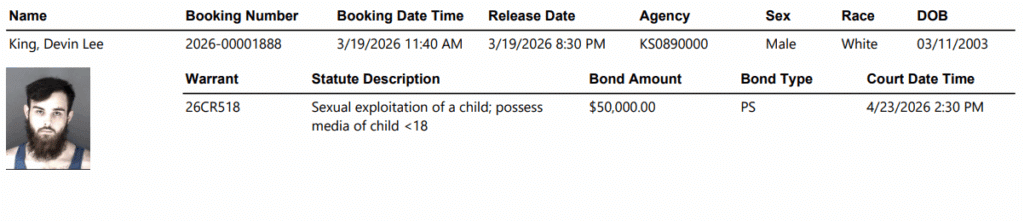
Devin Lee King.
Booked: 11:40 a.m.
Released: 8:30 p.m.
Let’s not overcomplicate this.
That’s not a stay.
That’s a pit stop.

That’s enough time to process paperwork, make a phone call, maybe sit on a bench long enough to realize you’re not staying — and then right back out the same doors you walked through.
Same day.
Same sunlight.
Same world.
Now sure — the system will tell you this is how it’s supposed to work. Bond is set. Bond is posted. The person is released. That’s the mechanism.
Clean. Efficient. Procedural.
But let’s talk about how it feels to the rest of the world watching it happen.
Booked before lunch.
Home before prime time.
And not for something small.
This isn’t a missed court date.
This isn’t unpaid tickets stacking up.
This is the kind of charge that makes people stop and read every word twice.
And yet the timeline?
Eight hours and fifty minutes.
You’ve had longer waits at the DMV.
Longer delays on a flight out of KCI.
Longer sits at a Friday night restaurant in this town.
But this?
In.
Processed.
Bonded.
Gone.
All before most people even knew it happened.
And that’s where the disconnect lives.
Because the system sees a checklist:
- Charge filed
- Bond set
- Bond posted
- Release authorized
Done.
But the public sees a clock.
And that clock says something different.
It says whatever happened was serious enough to bring someone in — but not serious enough to keep them there overnight.
And that’s a hard line for people to reconcile.
Again — nobody’s been convicted. That matters. It should matter.
But timing matters too.
Because when the turnaround is this fast, it doesn’t feel like accountability.
It feels like access.
Like if you can cover the number, you can cover the problem — at least for now.
And maybe that’s the real headline here:
Not just who got arrested.
But how quickly they didn’t stay.