
TOPEKA — Here’s the part they don’t say out loud: the system only works if people follow it.
And when it comes to registered sex offenders, the rules aren’t optional—they’re the bare minimum line between transparency and chaos.
This week, Matthew Kurtis Schick, a registered offender, was arrested and booked into the Shawnee County Jail for violating the offender registration act — a felony. That’s not a paperwork error. That’s not a technicality. That’s the law stepping in because someone who is required to be tracked… wasn’t playing by the rules.
Let’s break down what we’re looking at:
- Primary charge: Violation of the Kansas Offender Registration Act (KORA)
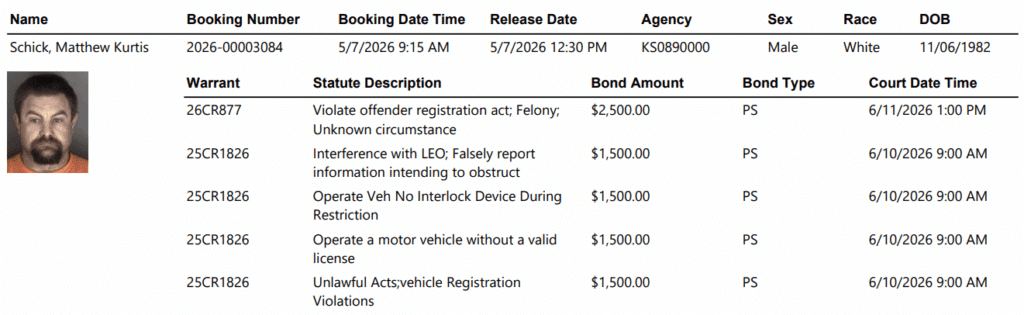
- Additional charges:
- Interference with law enforcement (false reporting)
- Driving without a valid license
- Operating a vehicle without an interlock device
- Vehicle registration violations
Bond stacked up across multiple counts. He was booked at 9:15 AM and released just hours later.
Hours.
Why This Matters More Than the Booking Sheet
The offender registry exists for one reason: public safety through visibility.
It’s not about punishment—it’s about accountability. When someone required to register fails to do so properly, it creates a blind spot. And blind spots are where bad things happen.
Violation of the registration act means:
- Failing to update an address
- Not reporting required information
- Attempting to obscure identity or location
In other words: disappearing from the system that’s designed to keep tabs on them.
And Then There’s This…
Interference with law enforcement—falsely reporting information—isn’t just noise. It raises a bigger question:
What was he trying to hide?
Because when someone is already under legal obligation to be transparent, and then allegedly feeds false information to law enforcement, that’s not a gray area. That’s intent.
Catch, Release… Repeat?
Booked. Processed. Released the same day.
We’ve said it before and we’ll say it again—the revolving door isn’t broken, it’s operating exactly as designed.
But here’s the problem: when the offense involves someone already flagged as a public safety risk, the margin for error shrinks to zero.
Bottom Line
This isn’t about one arrest. It’s about a system that relies on compliance—and what happens when that compliance disappears.
You don’t have to take a position on anything political to understand this:
If someone is required by law to be tracked…
and they stop following that law…
that’s a problem.
And it’s a problem worth paying attention to.
This Is Topeka will continue monitoring booking reports and offender registry compliance across Shawnee County. If you have information relevant to public safety concerns, contact us at [email protected].