

TOPEKA, Kan. — U.S. Sen. Roger Marshall smiled for the camera Friday outside the Boys & Girls Clubs of America site in Topeka, kneeling beside a young student flashing a peace sign. “Happy Friday … great to be here!” he wrote in a social media post, offering a familiar image of a lawmaker connecting with a cornerstone of local youth programming.
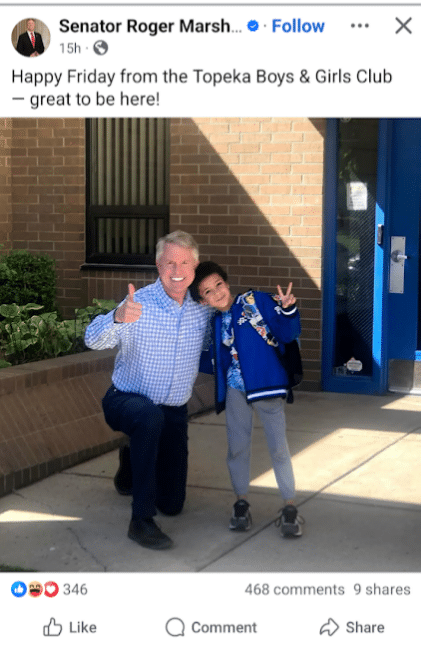
The visit, warm and uncontroversial on its face, arrives amid a broader and more complicated debate in Washington over the federal funding streams that help sustain organizations like the Boys & Girls Clubs — and Marshall’s role within that debate.
Across the country, Boys & Girls Clubs and similar after-school providers rely in part on federal programs such as the 21st Century Community Learning Centers initiative, a longstanding funding source for after-school and summer programming. Those funds are typically embedded in large appropriations packages — the same sweeping federal spending bills that have increasingly drawn opposition from fiscal conservatives, including Marshall, who has voted against several such measures in recent years.
Critics argue that those votes — and the broader policy direction aligned with efforts to shrink or restructure federal education spending — place lawmakers in a contradictory position: publicly embracing the visibility and community goodwill of youth organizations while supporting policies that could constrain their funding.
Marshall has not directly addressed recent controversies involving federal education grant freezes or proposed cuts to after-school funding streams that affect programs like those operated by Boys & Girls Clubs. His public statements have instead focused on a consistent theme: reducing federal spending, limiting what he describes as bureaucratic inefficiencies, and returning more control over education funding to states and local communities.
Supporters say that approach reflects a legitimate philosophical divide rather than a contradiction. In their view, backing the mission of youth organizations does not require endorsing federal funding mechanisms, particularly large, omnibus-style spending bills that bundle hundreds of programs into a single vote. They argue that community-based organizations could be supported through state funding models, local investment, or public-private partnerships.
But for organizations on the ground, the distinction between funding philosophy and funding reality can be consequential. Federal grants often serve as a stabilizing base, especially in lower-income communities where local funding options are limited. Even temporary disruptions — such as delays, reductions or uncertainty tied to federal policy decisions — can translate into staffing cuts, reduced programming or, in some cases, the threat of closure.
That tension remains largely unaddressed in Marshall’s public messaging.
While the senator’s visit to the Topeka Boys & Girls Club underscores his support for the organization’s work, it also highlights an unresolved question at the center of the national conversation: if federal funding streams are reduced or eliminated, what replaces them?
For now, that question remains open — even as the photo opportunities continue.