
By Lila Marquez
On the surface, it looks like something simple.
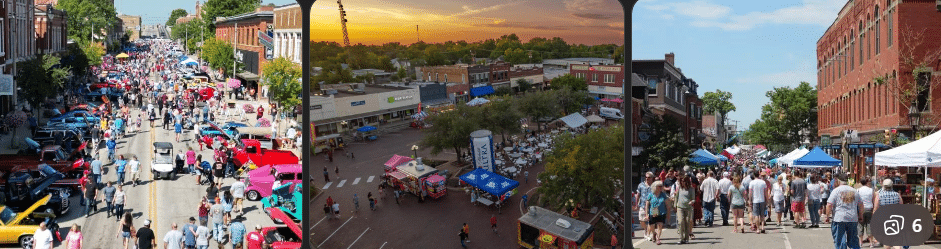
A small-town square in Holton fills up with classic cars, folding chairs, and people who haven’t seen each other since high school. Vendors line the sidewalks. A parade rolls through. Someone brings their kids. Someone brings their memories.
They call it Glory Days.
And in a lot of ways, that name does more work than the event itself.
Scheduled for May 23, 2026, the annual festival transforms Holton’s courthouse square into what organizers describe as a “high-energy community hub,” with a car show, alumni parade, and dozens of artisan vendors filling the morning and early afternoon.
But spend a little time looking closer, and the event starts to feel less like a festival—and more like a ritual.
A Day Built on Looking Back
The day begins early—8:00 a.m., with vendors expected to be set up and the square already filling with activity.
From there, it unfolds predictably:
- A flag-raising ceremony
- A steady stream of craft booths
- A car show full of polished nostalgia
- And, at 11:00 a.m., the centerpiece: the alumni parade
Class floats roll through town, decorated with decades of memory—1978, 1994, 2006—each one quietly asking the same question:
Do you remember when this place felt like yours?
Who Gets to Participate—and Who Doesn’t
There’s something else, too.
Buried in the vendor registration is a line that most people will scroll past:
Certain vendor categories—food, beverages, and even some direct sales—are no longer being accepted.
Instead, the focus shifts to “artisan and craft vendors.”
On paper, it’s about balance.
In reality, it’s about control—about curating the version of the town that gets displayed on that square.
Because events like this don’t just showcase a community.
They define it.
The Performance of “Community”
Glory Days is free to attend. Anyone can walk the square.
But belonging? That’s a little more complicated.
You see it in who has a booth.
You see it in who’s in the parade.
You see it in who’s watching from the curb—and who isn’t there at all.
It’s not exclusion in the loud, obvious sense.
It’s quieter than that.
It’s the kind of filtering that happens over years—through tradition, through familiarity, through the unspoken understanding of how things are done here.
Still—People Show Up
And maybe that’s the point.
Despite everything, people come.
They come for the cars.
They come for the vendors.
They come because someone they used to know might be there.
Or because, for a few hours, they can step into a version of the town that feels stable, familiar—untouched by everything else changing around it.
What Glory Days Really Is
It’s not just a festival.
It’s a snapshot of how a town sees itself—and how it wants to be seen.
Polished chrome.
Carefully chosen vendors.
A parade of memories rolling past on a Saturday morning.
And for a few hours in late May, under a Kansas sun with not enough shade, that version of the story holds.
At least until the square clears out.
And everyone goes back to the version of the town that doesn’t make the brochure.