

By This Is Topeka Staff
WABAUNSEE COUNTY, Kan. — A March 3 arrest involving a well-known local horse trainer, followed by her same-day release and the absence of any public record of the incident, is prompting questions about consistency and transparency at the Wabaunsee County Sheriff’s Office.

According to information obtained by This Is Topeka, and confirmed by the Wabaunsee county Sheriffs office, Amanda Lynch was arrested March 3 on a domestic violence-related allegation by the Wabaunsee County Sheriff’s Office. She was released the same day. As of publication, there are no known charges pending and no publicly available court case associated with the incident.
The Sheriff’s Office did not include the arrest in its public blotter or social media updates.
The following day, however, the agency shared a Facebook post encouraging community support for a family connected to Lynch. The post highlighted a serious medical diagnosis involving a child in the family and included a fundraising link, calls for donations, and expressions of support.
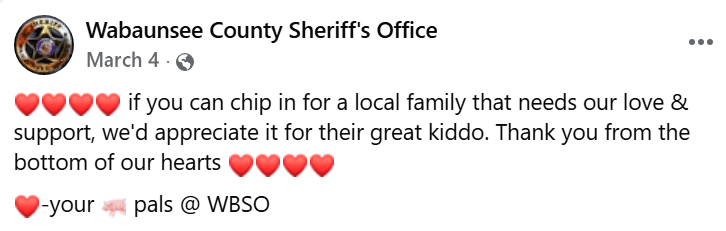

The post, which included multiple heart emojis and was signed by the department’s social media persona, urged the community to “chip in for a local family that needs our love & support.”
The juxtaposition of the two developments—an unpublicized arrest and a subsequent public show of support for the same family—has raised questions among some community members about how the agency communicates enforcement actions.
The Wabaunsee County Sheriff’s Office has gained broader attention in recent months for its unconventional and often humorous social media presence, which frequently emphasizes a strong stance on enforcement, particularly in cases involving protection orders.
In one recent post, the agency stated it maintains a “100% return you to jail rating” for violations of Protection From Abuse (PFA) and Protection From Stalking (PFS) orders, adding that such violations are “relentlessly investigated.”
However, procedures surrounding domestic violence arrests can vary by jurisdiction. In neighboring Shawnee County, individuals arrested for domestic violence involving a household member are typically held without bond until appearing before a judge, in accordance with standard policy.
It remains unclear why Lynch was released the same day as her arrest, and whether the circumstances of the case differed from typical domestic violence cases. Law enforcement agencies may release individuals if probable cause thresholds change, if evidence is insufficient, or at the direction of prosecutors.
Still, the absence of any public record of the arrest—combined with the department’s highly visible and often proactive social media communication—has led some to question whether all incidents are being reported consistently.
Additional context further complicates perceptions. Lynch’s husband has previously been associated with former Wabaunsee County Sheriff Robert Hoskins, a connection that, while not uncommon in smaller communities, contributes to scrutiny in cases involving discretionary decision-making.

Separately, Lynch’s sudden absence from her role as a horse trainer reportedly required others to step in to care for animals under her supervision, according to individuals familiar with the situation. That disruption has had practical consequences for clients and horse owners connected to the facility, who asked to remain anonymous, when Amanda Lynch left the horse facility which she leased and did not refund clients and left the land owner responsible for the boarded horses care, including a horse that need to be put down immediately after she abandoned it.
Legal experts note that an arrest without charges does not imply guilt, and the lack of a filed case suggests that prosecutors may have declined to proceed or that additional investigation is ongoing.
Even so, transparency in reporting arrests—particularly in cases involving domestic violence—remains a key expectation for many communities.
The Wabaunsee County Sheriff’s Office has not publicly commented on the March 3 arrest or the decision not to include it in public records.
As the agency continues to build a national profile through its online presence, the situation underscores a broader challenge for modern law enforcement: balancing personality-driven public engagement with consistent, transparent application of policy.
For now, questions remain—not only about what happened on March 3, but about how and when the public is informed when it does.