

Before Joshua Solis Was Killed: Years of Convictions, Suspended Prison Sentences and DUI Cases Followed Noah Metz
TOPEKA, Kan. — The arrest of Noah James Metz in connection with the hit-and-run death of 14-year-old Joshua Solis raises questions that extend well beyond what happened on SE 37th Street Wednesday night.
They reach back years.
Metz, 27, was booked into the Shawnee County jail at 7:10 a.m. Friday, September 25, on allegations of failure to stop at an accident resulting in death and felony interference with law enforcement. Booking records initially listed a $1 million bond; the current booking listing reviewed Saturday shows him held without bond.
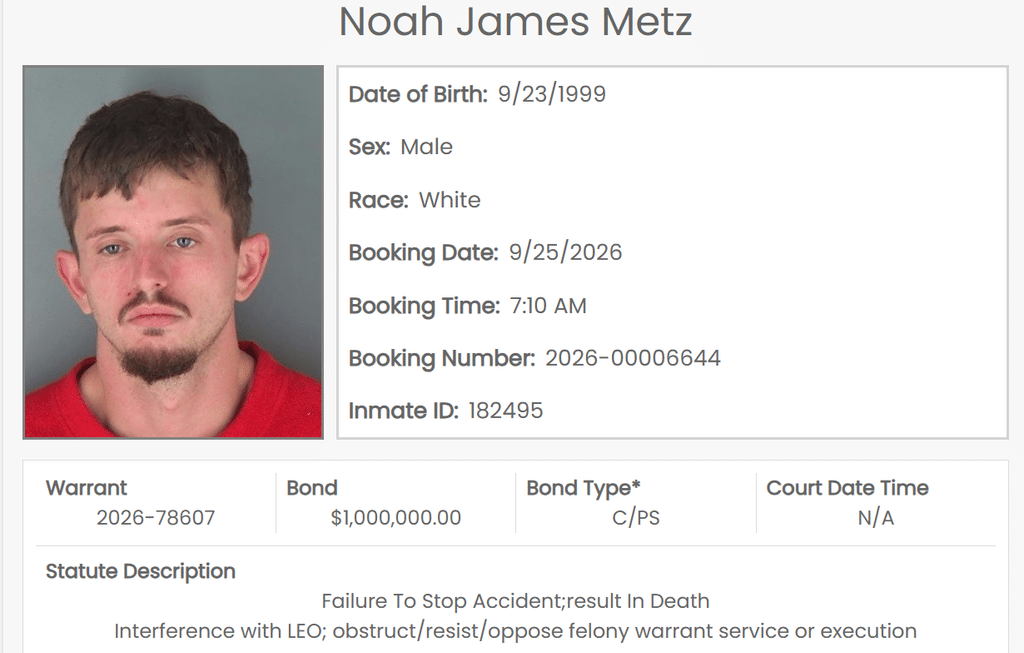
Metz has not been convicted of causing Joshua’s death, and police have not said that alcohol or drugs contributed to Wednesday’s collision.
But an examination by This Is Topeka of Metz’s court and booking history shows something that is now difficult to ignore: this was not his first encounter with the criminal justice system, nor his first involving dangerous driving, alcohol or drugs, suspended driving privileges, fleeing police or leaving an accident.
In several earlier cases, Metz wasn’t merely arrested.
He was convicted.
And on multiple occasions, substantial prison sentences were imposed but suspended while Metz was allowed to remain in the community under supervision.
A 14-year-old killed near Lake Shawnee
Joshua was struck shortly after 10:30 p.m. Wednesday in the 2200 block of SE 37th Street near Lake Shawnee.
The driver left the scene.
Investigators subsequently circulated images of a white Jeep Compass they believed was involved and asked the public for assistance. Two days later, Metz was arrested.
The tragedy is devastating on its own.
But Metz’s history raises a broader public-interest question: Were there opportunities before September 23 to prevent another dangerous encounter on the road?
The records don’t provide a simple answer.
They do, however, establish a lengthy chronology.
Felony conviction — and a suspended 60-month sentence
One of the most consequential cases began in 2020.
Metz was charged with residential burglary, contributing to a child’s misconduct, theft of a firearm, misdemeanor theft and drug offenses.
Court records supplied to This Is Topeka show Metz ultimately pleaded guilty to the felony burglary charge on February 26, 2021.
The sentence recorded by the court was substantial: 60 months with the Kansas Department of Corrections.
But Metz did not serve that five-year prison sentence in full.
The court record states that the penitentiary sentence was suspended. Metz received credit for 118 days already spent in custody and was placed on 36 months of supervised probation with intensive supervision.
The court also ordered alcohol and drug treatment and compliance with treatment recommendations.
In other words, Metz had been given a lengthy underlying prison sentence, but also an opportunity to remain in the community under supervision.
Another felony. Another suspended prison sentence.
A separate case stemming from May 2018 produced another felony conviction.
Metz was originally charged with multiple offenses involving the burglary of vehicles, theft of a firearm, theft and unlawful discharge of a firearm.
He ultimately pleaded guilty to burglary of a vehicle with intent to steal a firearm, a Level 5 felony. The remaining counts were dismissed.
The sentence was 34 months with the Department of Corrections, according to the court record provided to This Is Topeka.
Again, the prison sentence was suspended.
Metz received credit for 268 days and was placed on 36 months of supervised probation with intensive supervision. The sentence again required alcohol and drug treatment.
The 34-month sentence was ordered consecutive to the sentence in his other case, according to the record.
Guilty plea for interfering with law enforcement
Another felony case originated in March 2018.
Metz faced allegations of identity theft and interfering with law enforcement by falsely reporting a felony with the intent to obstruct authorities.
The identity-theft count was dismissed.
Metz pleaded guilty to felony interference with law enforcement.
Court records show a 12-month Department of Corrections sentence that was also suspended, with Metz placed under supervised probation through Community Corrections and intensive supervision.
And this record contains another important detail.
It documents a violation sanction.
Metz was ordered to spend three days in the Shawnee County Jail, with credit for time served.
The records therefore show that community supervision was not merely theoretical. The court had reason during at least one case to impose a sanction related to a violation.
DUI history becomes particularly relevant
Metz’s driving record deserves separate attention because of the allegation he now faces.
Court records provided to This Is Topeka show an earlier case involving DUI with a child present, driving while suspended and other traffic offenses.
The case ultimately resulted in guilty pleas and sentencing that included jail time, fines and supervised probation.
But Metz’s encounters involving driving did not end there.
Earlier this year, he was booked again on a DUI allegation. The February 2026 booking information supplied to This Is Topeka described the DUI allegation as involving a third conviction and also listed allegations of transporting an open container and operating a vehicle without a required ignition-interlock device.
Then, in April, Metz was arrested in Jackson County.
That booking included allegations of third-offense DUI within 10 years, driving while his license was cancelled, suspended or revoked, reckless driving, interference with law enforcement, marijuana possession and aggravated assault of a law-enforcement officer.
Those are allegations, not convictions.
But the timeline continued.
May: fleeing police, reckless driving and suspended license allegations
On May 13—only a little more than four months before Joshua’s death—Metz was booked again in Shawnee County.
This time the allegations included felony fleeing or attempting to elude police, reckless driving, driving while suspended, interference with law enforcement, criminal possession of a weapon and drug-distribution offenses, along with numerous traffic allegations.
Again, unresolved allegations must not be confused with convictions.
But taken together with the established convictions, they demonstrate that Metz continued encountering law enforcement after receiving probation, intensive supervision and substance-abuse treatment requirements in previous cases.
He had even been accused of leaving an accident before
Then there is a July 2025 case that bears a striking resemblance to one aspect of the allegation Metz faces today.
Metz was booked on allegations including leaving the scene of a non-injury accident involving more than $1,000 in damage, interference with law enforcement and assault of a law-enforcement officer.
That case was later dismissed, according to court information previously reviewed by This Is Topeka.
A dismissal matters. It means the arrest cannot fairly be characterized as a conviction, and the publicly available information does not establish why prosecutors did not proceed with the case.
Still, its place in the chronology is noteworthy.
Another guilty plea in 2023
There were other cases as well.
In a 2022 Shawnee County case, Metz was initially accused of criminal damage to property.
The charge was subsequently reduced to disorderly conduct as part of a plea, according to the court record supplied to This Is Topeka.
On August 8, 2023, Metz pleaded guilty.
Viewed individually, that misdemeanor might have little relevance to Wednesday night’s tragedy.
Viewed alongside the rest of the record, however, it documents another occasion when Metz returned to court after his earlier felony convictions and probationary sentences.
So did the system give Metz too many chances?
That’s the question many people looking at this record may understandably ask.
The evidence currently available does not justify answering it with a simple yes or no.
Probation, treatment and intensive supervision exist for legitimate reasons. Kansas sentencing decisions depend on the severity of the crime, criminal-history classifications, sentencing guidelines, plea agreements and numerous other factors. A suspended sentence does not mean there were no consequences.
Metz also spent significant periods in custody. Court records credit him with 268 days in one case and 118 days in another.
And no judge sentencing Metz years ago could have known that Joshua Solis would be killed on September 23, 2026.
But those facts don’t end the inquiry.
They make it more important.
What happened to all that supervision?
Metz had been sentenced to 60 months in one felony case and 34 months in another.
Both prison sentences were suspended.
He was placed on supervised probation and intensive supervision.
He was ordered into alcohol and drug treatment.
He had a documented violation sanction.
He had previous DUI and suspended-driving cases.
Then came additional allegations involving DUI.
Then driving while suspended.
Then reckless driving.
Then allegedly fleeing police.
And now police allege Metz left the scene after a collision that killed a 14-year-old boy.
There are critical pieces of the record still missing.
Did Metz successfully complete his probation?
Did he complete the substance-abuse treatment ordered by the court?
How many probation violations occurred?
Were prosecutors ever asked to revoke his probation and execute either suspended prison sentence?
What happened to his driver’s license after the previous DUI cases?
Why was he allegedly driving without an ignition-interlock device earlier this year?
What was the disposition of each recent driving case?
And most importantly: what restrictions and court orders were actually in effect on the night Joshua died?
Those questions cannot responsibly be answered from booking photographs or charge lists.
They require court files.
A tragedy at the end of a long timeline
There is also one line that shouldn’t be crossed.
Nothing currently reviewed by This Is Topeka establishes that Metz was intoxicated when Joshua was struck. His DUI history makes his driving record newsworthy, but it would be wrong to use that history to imply impairment Wednesday night without evidence.
Likewise, Metz’s arrest does not establish his guilt in Joshua’s death.
He is entitled to the presumption of innocence on the new allegations.
But his previous guilty pleas and sentences are established court history, and that history shows years of intervention by police, prosecutors, judges, probation officers and treatment programs.
Some resulted in incarceration.
Others resulted in probation.
Twice, substantial underlying prison sentences were suspended.
And repeatedly, Metz returned to the criminal-justice system.
Now a child is dead.
That does not prove that the criminal courts caused Joshua Solis’s death or that any single earlier decision could have prevented it.
It does mean the public is entitled to ask whether the system designed to intervene before conduct escalates worked as intended—and, if it didn’t, where it failed.
This Is Topeka will continue examining Metz’s court files, probation history and recent cases to answer those questions.
Noah James Metz has not been convicted in connection with Joshua Solis’s death. Charges and booking allegations referenced in this article are identified as allegations unless court records establish a conviction or guilty plea.