
OPINION | THIS IS TOPEKA | NOVEMBER 1, 2026
The stock market can soar. Household income can set records. But in the aisles where working families shop, America’s economic success story looks a little different.
By Jeffery Fogg | This Is Topeka
The night before Halloween, my wife and I stopped at Walmart in Topeka to pick up a few last-minute things.
Nothing unusual. Just another errand in the middle of an ordinary week, the kind of trip millions of working families make without thinking much about it.
But something caught my attention.
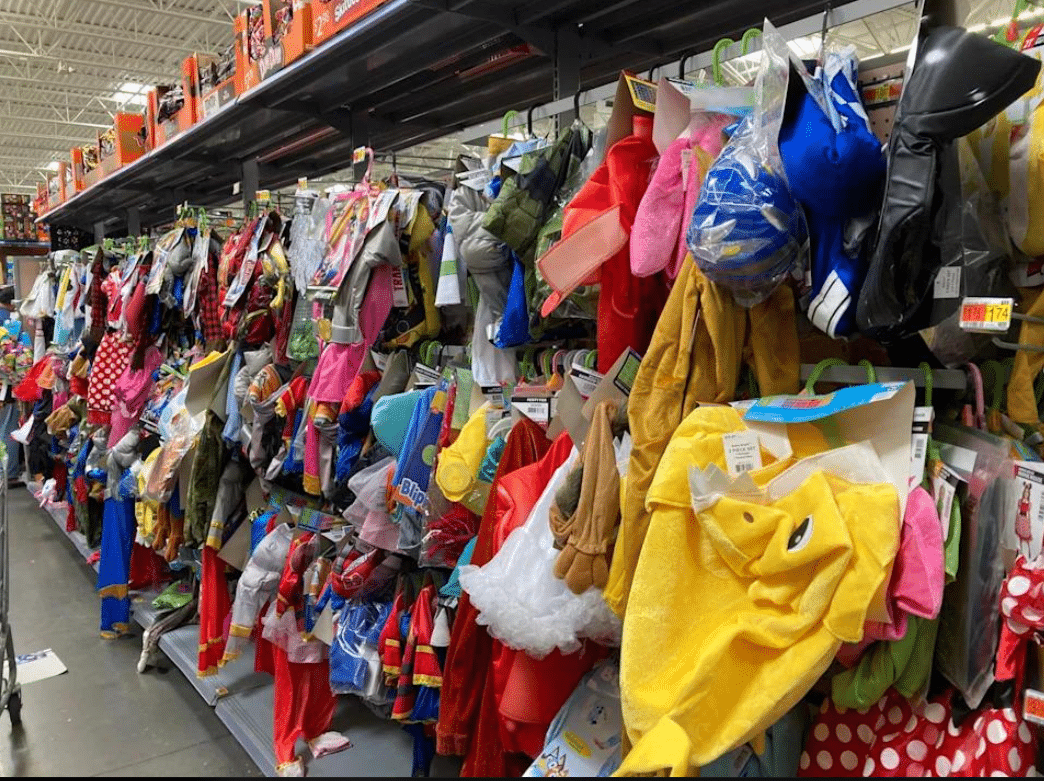
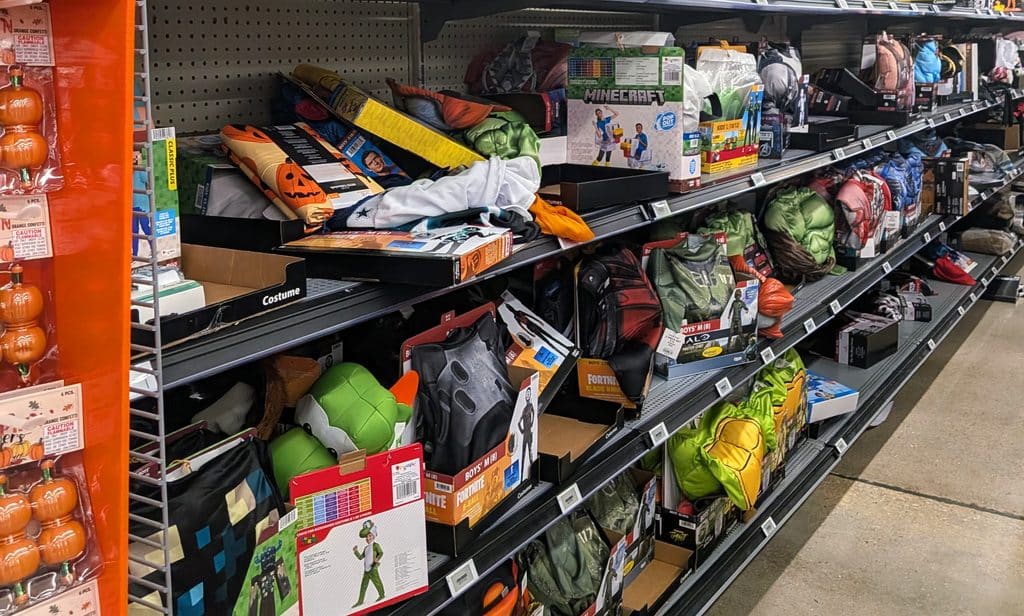
The Halloween costumes were still there.
Not a handful of leftovers. Not a few picked-over costumes in sizes nobody wanted. Entire sections of costumes remained hanging on the racks. Princess dresses. Superheroes. Minecraft characters. Costumes for little girls and boys. Rows and rows of them.
And I found myself wondering: Why?
My wife and I moved to Topeka in 2020, right in the middle of COVID. Since then, we’ve learned a fairly simple rule about shopping here: If you want something for a holiday, buy it the moment the stores put it out.
Wait until the week before Christmas? Good luck.
Need something for Halloween a few days before the holiday? You probably should have thought about that in September.
Topeka is a big little city. We have most of what we need, but we don’t exactly have an endless selection of places to shop. And when you’re raising a family and watching your budget, Walmart is often the cheapest practical option.
So, for years, we learned to shop early.
Yet there we were, on October 30, looking at racks full of costumes.
Maybe Walmart ordered too many. Maybe shopping patterns changed. Maybe more people bought online. A single store aisle cannot tell us exactly what happened.
But standing there, I couldn’t shake another possibility.
What if people simply couldn’t afford them?
And what does it say about our country when buying a Halloween costume for your child becomes one more expense a family has to think twice about?
The economy looks different depending on where you’re standing
There is an economy that exists on television, in financial newspapers, and on Wall Street.
Then there is the economy that exists at Walmart.
The first economy talks about markets, investment returns, quarterly earnings, gross domestic product and shareholder value.
The second economy talks about whether you can put $40 in your gas tank and still have enough money for groceries.
I’ve lived in poverty. Not the kind of poverty where you occasionally have to skip a restaurant meal. The kind where surviving becomes the organizing principle of your life.
My family is in a better position today. We’ve worked hard, pursued education, and built a life that is more stable than the one we once had.
But climbing out of poverty doesn’t mean you’ve suddenly entered the world of financial security.
Sometimes it just means you’re struggling less than you used to.
You still watch what things cost. You still worry about unexpected expenses. You still recognize that the difference between doing okay and being in trouble can be a car repair, a medical bill, or a few missed paychecks.
And you begin to notice something disturbing.
You can do everything society tells you to do — work hard, get educated, raise a family, pay your taxes — and still find yourself locked out of things that previous generations considered ordinary.
Like buying a newly constructed home.
Or saving enough money that an emergency doesn’t become a financial crisis.
Or buying your kid a Halloween costume without having to rearrange the family budget.
The numbers tell a story politicians don’t like discussing
To be fair, some economic indicators really have improved.
The Census Bureau reported that inflation-adjusted median household income reached $87,460 in 2025, an increase of 2.6% from 2024 and the highest recorded since its series began in 1967. The official poverty rate also declined to 10.2%. Those are genuine improvements, and pretending otherwise wouldn’t help anyone. Census.gov+1
But those national figures don’t capture every household’s circumstances, and the more recent wage numbers are less reassuring.
In September 2026, the Bureau of Labor Statistics reported that average hourly earnings, adjusted for inflation, fell 0.7% over the preceding 12 months. In other words, the average worker’s hourly paycheck was buying a little less than it had a year earlier. 2026 M09 Results
Think about that.
A person can receive a raise and still lose purchasing power.
A family can bring home more dollars and still have less room to breathe.
That is the difference between making more money and actually getting ahead.
And it’s a distinction that matters enormously when you’re shopping for a Halloween costume at Walmart.
When a $400 emergency is a problem
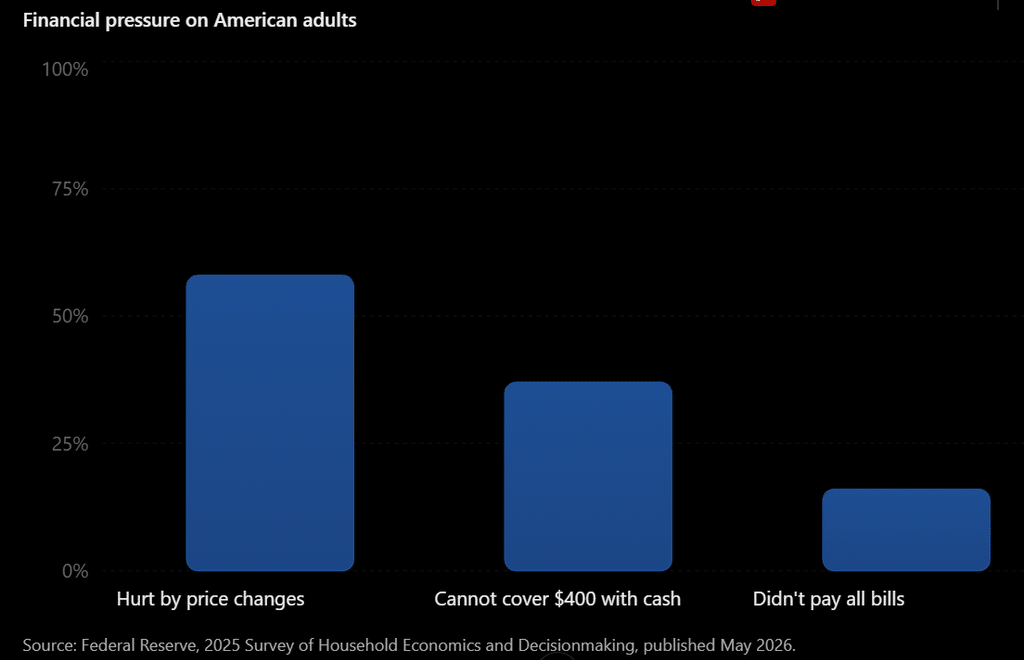
The Federal Reserve’s 2025 household survey, published in May 2026, found that 63% of American adults could cover a hypothetical $400 emergency using cash, savings or the equivalent.
That means 37% could not cover it entirely that way.
The same survey found that 16% of adults had failed to pay all their bills in the previous month. And 58% said price changes over the preceding year had made their financial situation worse. May 2026
Financial pressure on American adults
Didn’t pay all bills
Share of adults16%
0%25%50%75%100%Hurt by price changesCannot cover $400 with cash equivalentDidn’t pay all bills
Source: Federal Reserve, 2025 Survey of Household Economics and Decisionmaking, published May 2026.
Different survey measures and time frames; percentages are not additive.
These aren’t necessarily people who refuse to work.
They are your coworkers. Your neighbors. The people who build your houses, stock your shelves, care for your parents, serve your food and keep the city running.
They are the people whose lives depend on a functioning automobile because public transportation isn’t a realistic substitute for every job, school schedule and family obligation.
When gas goes up, they can’t simply decide not to buy it.
When rent increases, they can’t simply decide not to live somewhere.
And when the grocery bill rises, they can’t tell their children to stop being hungry.
The economy doesn’t ask whether these families can afford another price increase.
It just sends them the bill.
Our children are already paying the price
This is where the conversation stops being abstract.
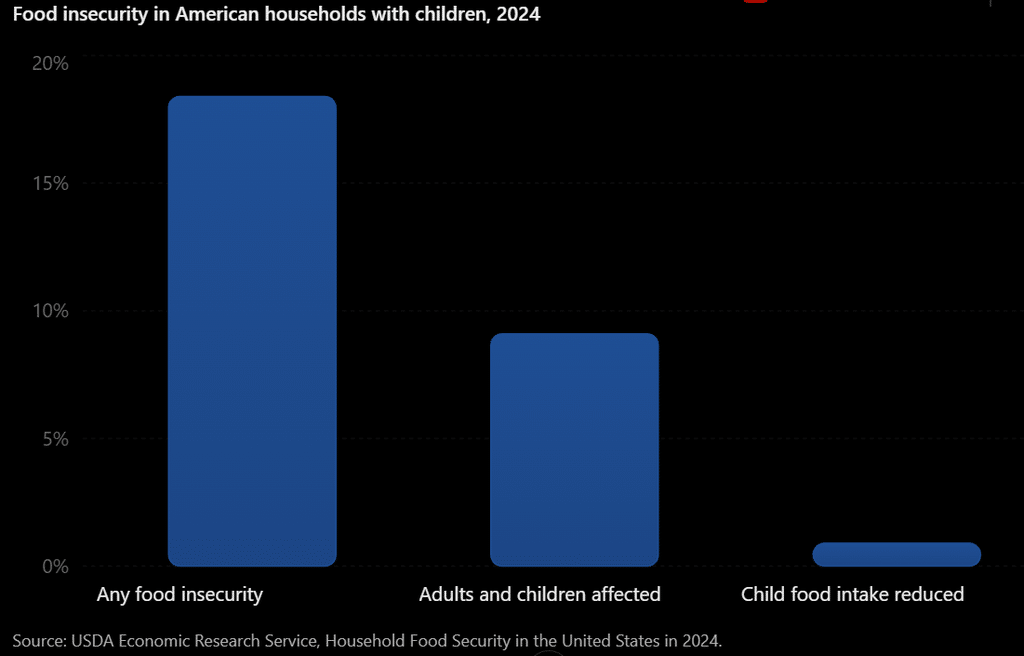
According to the U.S. Department of Agriculture, 18.4% of American households with children experienced food insecurity at some point during 2024.
That’s approximately 6.7 million households.
In 9.1% of households with children, both adults and children experienced food insecurity. In about 318,000 households, at least one child experienced disruptions in eating patterns and reduced food intake because of insufficient resources. Economic Research Service
Food insecurity in American households with children, 2024
Child food intake reduced
Households0.9%
0%5%10%15%20%Any food insecurityAdults and children affectedChild food intake reduced
Source: USDA Economic Research Service, Household Food Security in the United States in 2024.
The categories overlap. These are national 2024 figures, not estimates for Halloween 2026 or Topeka specifically.
I want people to really consider what those numbers mean.
There are American parents who are eating less so their children can eat.
There are children living in households where the family doesn’t always have the resources to provide enough food.
And we’re supposed to be satisfied because some economic indicator somewhere is moving in the right direction?
A Halloween costume is not food. It isn’t rent. It isn’t medicine.
But that’s precisely the point.
When families are struggling to afford necessities, the little things that make childhood special become negotiable.
The costume can wait.
The school activity can wait.
The birthday party can be smaller.
The family vacation can be canceled.
Eventually, childhood itself becomes a series of things parents wish they could afford to give their children.
And that should bother every one of us.
We are working. So why are we still struggling?
There is a particular kind of exhaustion that comes from working more than 40 hours a week and realizing that hard work alone isn’t enough.
We have been told, generation after generation, that work is the path to stability.
Get an education. Find a career. Work hard. Be responsible.
But what happens when two adults working full time still struggle to qualify for a new home?
What happens when the people building those homes can’t afford to buy them?
What happens when an increase in wages is swallowed by housing, transportation, insurance, food and utilities?
At some point, we have to stop treating every struggling household as an individual failure and start examining the economic structure producing so much financial insecurity.
And yes, that means examining the corporations that profit from necessities.
Oil companies operate in a system that includes favorable tax provisions and government support, while the families buying their products often have no realistic alternative.
I don’t begrudge anyone a successful business.
But I do question an economic system that can reward ownership so generously while leaving the people whose labor makes that success possible wondering whether they can afford a costume for their child.
We have confused corporate prosperity with public prosperity.
They are not the same thing.
Poverty doesn’t end when your income improves
One of the strangest things about escaping poverty is that you don’t necessarily stop thinking like someone who is poor.
You remember what it was like to have nothing.
You remember the decisions you had to make.
You remember that a $100 problem could become a $1,000 catastrophe because you didn’t have the money to fix it when it was small.
And even after your circumstances improve, you recognize the same fear in other people.
I think that is part of what bothered me about those costumes.
I wasn’t looking at them as a retail analyst.
I was looking at them as a father.
As someone who has struggled.
As someone who knows that when a parent tells a child, “Maybe next year,” there is often a much bigger story behind those three words.
Maybe the family already spent too much on groceries.
Maybe the car payment is due.
Maybe someone missed a day of work.
Maybe the electric bill was higher than expected.
Or maybe they simply don’t have another $30 to spend.
We cannot establish from those photographs that any particular family went without a costume. But we have more than enough evidence that millions of American families are making difficult financial choices.
And those choices deserve more attention than they receive.
Fuck ideology. Fix the system.
I am tired of being told that the solution depends on whether a politician has an R or a D next to their name.
I’m tired of the political theater.
I’m tired of hearing people who have never worried about their next meal lecture working families about personal responsibility.
And I’m tired of an economic debate in which the success of corporations and investors is treated as proof that everyone else must be doing fine.
Fuck ideology.
If a policy makes housing more affordable, let’s talk about it.
If it lowers the cost of healthcare, let’s consider it.
If it helps families keep more of their wages, reduces the cost of essential transportation, or makes it possible for working parents to raise children without constant financial anxiety, it deserves serious consideration.
I don’t particularly care which political party gets credit.
I care whether it works.
And I believe we need changes far more substantial than another campaign slogan, temporary rebate or promise that prosperity will eventually trickle down.
We need to ask why full-time employment no longer guarantees even a reasonable chance at financial security for so many households.
We need to ask why housing costs are so disconnected from what ordinary workers can afford.
We need to examine the relationship between public subsidies, corporate profits and the actual benefits delivered to taxpayers.
And we need to stop pretending that a growing national economy automatically means the people living in that economy are thriving.
Because some aren’t.
Some are barely holding on.
The costumes were still there
I don’t know exactly why those Walmart shelves were still full the night before Halloween.
Maybe the answer is nothing more complicated than an overly optimistic purchasing manager.
I hope that’s the answer.
I hope every child in Topeka who wanted to dress up for Halloween had the opportunity.
I hope every parent who walked through those aisles was able to buy what they needed without worrying about what bill might go unpaid.
But I also know what the economic data tells us.
Millions of families are struggling to afford food. More than a third of adults cannot cover a $400 emergency entirely with cash or its equivalent. And the average worker’s inflation-adjusted hourly earnings were lower this September than they were a year ago.
Those are not ideological opinions.
Those are economic realities.
And perhaps that’s what we need to pay more attention to.
Not just what the stock market is doing.
Not just how much the wealthiest Americans are worth.
Not just whether corporate earnings exceeded expectations.
But whether a mother and father, both working hard, can walk into Walmart on October 30 and buy their child a Halloween costume without worrying about how they’re going to pay for everything else.
Because that, to me, is a much more meaningful measure of the American economy.
And until we start measuring success by the lives ordinary people can actually afford to live, we’re going to keep celebrating an economy that looks wonderful from the top.
While the rest of us are left staring at the shelves.
Jeffery Fogg is the publisher of This Is Topeka. This column reflects his personal views.