

By Mack Callahan
At some point, even the most patient observer has to ask a basic question: how many times does the same story need to repeat before we stop pretending it’s a coincidence?
Because here we are again.
Floyd Gary Hester Jr., 40, was booked late Sunday night—December 28, 2025, at 11:20 p.m.—on a fresh set of violent felony charges involving firearms and property damage. The booking number is new. The case number is new. The allegations, however, are painfully familiar.
The Latest Arrest
According to Shawnee County booking records, Hester is now facing:
- Aggravated assault; use of a deadly weapon
- Criminal discharge of a firearm; recklessly at an occupied vehicle
- Criminal damage to property ($1,000–$25,000)
- Unlawful discharge of a firearm within city limits
Each charge carries a $25,000 cash or professional surety bond.
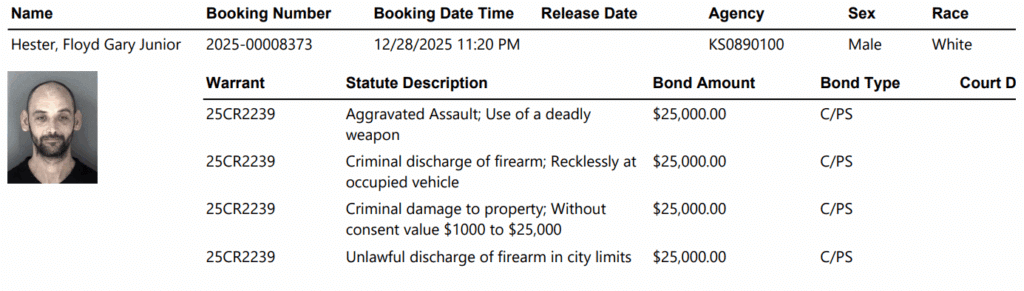
These appear to be new charges, not holdovers—new booking number, new case designation.
The Part That Should Sound Familiar
Because this isn’t Hester’s first time appearing in a violent firearms case.
Back in September 2025, Hester was arrested in connection with a homicide investigation in the 1200 block of SW Polk, an area that has become far too recognizable in police blotters.
That September arrest included allegations of:
- Aggravated assault with a deadly weapon
- Aggravated burglary
- Criminal discharge of a firearm at an occupied vehicle
- Criminal damage to property ($1,000–$25,000)
At the time, the bond status was simple:
No bond.
Same name.
Same birthdate.
Same categories of violence.
Same weapons.
Different night.
The Question No One Likes Asking
This column isn’t about guilt or innocence—that’s for the courts. This is about pattern recognition, something the public is very good at and institutions often pretend not to see.
When someone is arrested in connection with a homicide-area shooting in September and then turns up again in December with new firearm-related felony charges, the issue is no longer just an individual. It’s a system that keeps looping.
We are told enforcement is happening.
We are told arrests are being made.
We are told bonds are being set.
And yet the gunfire keeps echoing through the same neighborhoods.
Catch & Release Isn’t a Catchphrase—It’s a Record
The phrase “catch and release” isn’t hyperbole when booking reports read like sequels instead of conclusions.
If accountability only exists at the moment of arrest—but dissolves somewhere between paperwork, bond hearings, and back-on-the-street reality—then the system isn’t broken.
It’s functioning exactly as designed.
And the public is left counting the shots.
Editor’s note: All charges are allegations. Defendants are presumed innocent unless and until proven guilty in a court of law. This column relies solely on publicly available booking information.